Industrial History Online
Tracked hovercraft test track
Key Words :- hovertrain
Address :- Old Bedford Barrier Bank, Sutton, Cambridgeshire
Grid Ref :- TL 41832 78902
Co-ordinates :- Lat 52.389777 , Long 0.082779
Local Authority :- East Cambridgeshire District Council
Pre 1974 County :- Cambridgeshire
Site Status :- Site demolished or no longer extant
Description and History of Site:-
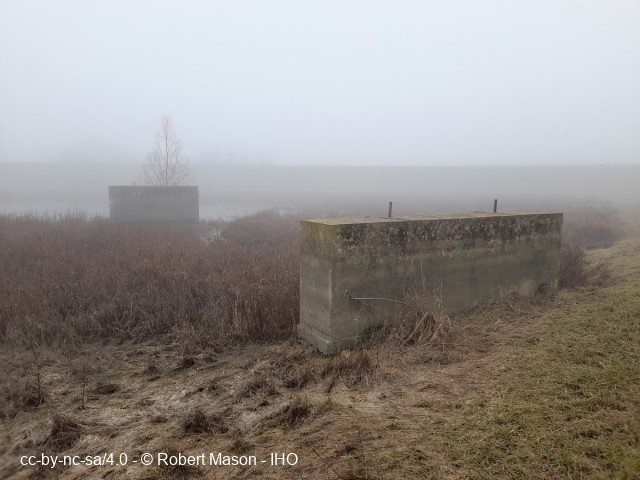
Three concrete bases, the remains of an elevated concrete 'guideway' for the experimental hovertrain experiment.
Information panel reads:
Straight as a die - the Hovertrain Experiment at Earith
The landscape in front of you is well known for its part in the drainage of the Fens, but fewer people know of the role which the straight alignment of the Ouse Washes played in the development of high speed transport. Forty years before the St Ives to Cambridge guided busway, an elevated concrete track was built beside the Bedford River from Earith to Sutton Gault to test a radically new form of transport - the tracked hovercraft.
The train was designed to ride on a cushion of air astride a concrete track, powered by a then novel linear electric motor. The application in 1967 to the Great Ouse River Authority specified a 20 mile track between Earith and Welney. A project office was set up in Cambridge, with the engineering workshop at Earith. Construction of the test track started in 1970 with the construction of pillar foundations. Delivery of the long concrete beams by road sadly required the demolition of the historic George and Dragon pub in Earith, where the village sign now stands. Achieving the tolerance required proved challenging and civil engineers remember working atop swaying beams in wild weather.
Technical success
After technical difficulties caused by the soft fenland soils, test runs with the remote controlled RTV31 started in 1971. This was a half-size prototype, powered via rails on either side of the track. The telemetry equipment which radioed test data from RTV31 back to a computer in the workshop was cutting edge for its time, but considerably less capable than today's cheapest mobile phones! By 1973, hovertrain tests had reached a record 107mph, limited by the one mile length of track which had been completed.
Economic failure
By 1973 technical testing was going well, but questions were being asked about the cost of building a national network of new elevated concrete tracks. British Rail was working on its own tilting train to run on the existing railway, while government policy still favoured the building of motorways. No overseas customer was prepared to adopt an untried technology without commitment in Britain. On Valentine's Day 1973, the government closed the project and 150 Cambridgeshire workers lost their jobs. The cancellation subsequently caused political controversy with Michael Heseltine accused of misleading the House of Commons.
What remains?
The test track was removed when the project was cancelled in 1973 and the two (sic, three) pillars here at The Gullet are the only survivors. The hardened access roadway outside the floodbank survives, while the buildings at Earith are now in industrial use. The RTV31 test vehicle, together with a length of track, is preserved at the Railworld Museum in Peterborough.
Though high-speed conventional railways were generally preferred to the Tracked Hovercraft technology, related technology was used in the Maglev transfer shuttle at Birmingham Airport for many years. Ultra high speed transport systems now being built in Germany and China build on lessons learned here in the Cambridgeshire Fens.
Today the Washes are managed as a wildfowl reserve and can be explored using public rights of way. It is now hard to imagine RTV31 flying by at over 100mph.
The Bedford Level Experiment
The Tracked Hovercraft engineers were not the first to use this landscape for scientific experiments. In Victorian times, the Ouse Washes were used to settle a wager on the curvature of the earth.
The experiment was conducted by Alfred Russell Wallace, a noted evolutionist. It involved sighting from the Welney bridge onto markers place along the long straight watercourse. The disputed results and ensuing legal wrangles are still quoted in Flat Earth discussions today.
Further Reading and References:-
http://www.ousewashes.info/experiments/hovertrain.htm
https://www.railworld.org.uk/history
Help us improve this entry
Grid Ref :- TL 41832 78902
Co-ordinates :- Lat 52.389777 , Long 0.082779
Local Authority :- East Cambridgeshire District Council
Pre 1974 County :- Cambridgeshire
Site Status :- Site demolished or no longer extant
Three concrete bases, the remains of an elevated concrete 'guideway' for the experimental hovertrain experiment.
Information panel reads:
Straight as a die - the Hovertrain Experiment at Earith
The landscape in front of you is well known for its part in the drainage of the Fens, but fewer people know of the role which the straight alignment of the Ouse Washes played in the development of high speed transport. Forty years before the St Ives to Cambridge guided busway, an elevated concrete track was built beside the Bedford River from Earith to Sutton Gault to test a radically new form of transport - the tracked hovercraft.
The train was designed to ride on a cushion of air astride a concrete track, powered by a then novel linear electric motor. The application in 1967 to the Great Ouse River Authority specified a 20 mile track between Earith and Welney. A project office was set up in Cambridge, with the engineering workshop at Earith. Construction of the test track started in 1970 with the construction of pillar foundations. Delivery of the long concrete beams by road sadly required the demolition of the historic George and Dragon pub in Earith, where the village sign now stands. Achieving the tolerance required proved challenging and civil engineers remember working atop swaying beams in wild weather.
Technical success
After technical difficulties caused by the soft fenland soils, test runs with the remote controlled RTV31 started in 1971. This was a half-size prototype, powered via rails on either side of the track. The telemetry equipment which radioed test data from RTV31 back to a computer in the workshop was cutting edge for its time, but considerably less capable than today's cheapest mobile phones! By 1973, hovertrain tests had reached a record 107mph, limited by the one mile length of track which had been completed.
Economic failure
By 1973 technical testing was going well, but questions were being asked about the cost of building a national network of new elevated concrete tracks. British Rail was working on its own tilting train to run on the existing railway, while government policy still favoured the building of motorways. No overseas customer was prepared to adopt an untried technology without commitment in Britain. On Valentine's Day 1973, the government closed the project and 150 Cambridgeshire workers lost their jobs. The cancellation subsequently caused political controversy with Michael Heseltine accused of misleading the House of Commons.
What remains?
The test track was removed when the project was cancelled in 1973 and the two (sic, three) pillars here at The Gullet are the only survivors. The hardened access roadway outside the floodbank survives, while the buildings at Earith are now in industrial use. The RTV31 test vehicle, together with a length of track, is preserved at the Railworld Museum in Peterborough.
Though high-speed conventional railways were generally preferred to the Tracked Hovercraft technology, related technology was used in the Maglev transfer shuttle at Birmingham Airport for many years. Ultra high speed transport systems now being built in Germany and China build on lessons learned here in the Cambridgeshire Fens.
Today the Washes are managed as a wildfowl reserve and can be explored using public rights of way. It is now hard to imagine RTV31 flying by at over 100mph.
The Bedford Level Experiment
The Tracked Hovercraft engineers were not the first to use this landscape for scientific experiments. In Victorian times, the Ouse Washes were used to settle a wager on the curvature of the earth.
The experiment was conducted by Alfred Russell Wallace, a noted evolutionist. It involved sighting from the Welney bridge onto markers place along the long straight watercourse. The disputed results and ensuing legal wrangles are still quoted in Flat Earth discussions today.
http://www.ousewashes.info/experiments/hovertrain.htm
https://www.railworld.org.uk/history
The compilers welcome corrections or additional information on all sites.
Any information provided will be verified before appearing on the web site.
Email comments
Contributor :- Cambridge IAG - 31 October 2022
Copyright :- cc-by-nc-sa 4.0 © Cambridge IAG
Copyright :- cc-by-nc-sa 4.0 © Cambridge IAG