Industrial History Online
Masons Arms crossing
Key Words :- railway
Address :- Shildon, Durham
Grid Ref :- NZ 2287 2565
Co-ordinates :- Lat 54.625476 , Long -1.647298
Local Authority :- Durham County Council
Pre 1974 County :- County Durham
Site Status :- Site extant - No Protection
Description and History of Site :-
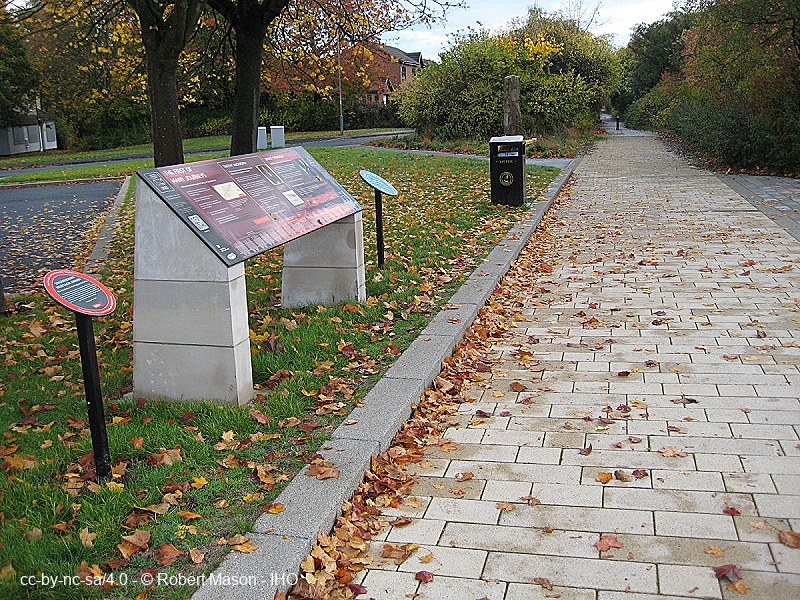
Various objects and memorials to the place where Locomotion began its historic journey on the Stockton & Darlington Railway, driven by George Stephenson on 27 September 1825.
Information panel:
"You are standing at the Masons Arms Crossing, a place of importance in world history where on the 27th of September 1825 the steam engine 'Locomotion No.1' began a journey first hauling coal, goods and passengers to Darlington and then on to Stockton. Thousands of people came to watch this new technological marvel, and instead of an expected few hundred passengers significantly more clambered on board for the ride that day. The S&DR was designed and engineered by George Stephenson and financed by the business community of south Durham and North Yorkshire, inspired by the vision of the Quaker merchant Edward Pease. This was the beginning of the railway age, and inspired by the S&DR, railways were soon being built across Europe and the USA. This transformed the world with the fast movement of people and goods changing people's lives as dramatically as the internet has in the 21st century.
Before the S&DR there was nothing here at New Shildon. John Dixon who surveyed the line in 1821 remembered that 'the site of New Shildon Works was a wet, swampy field a likely place to find a snipe, or a flock of peewits'. Within a few years it had become the world's first railway town with houses, schools, chapels and the engine and waggon works; a proud tradition carried on until 1984 when the works closed.
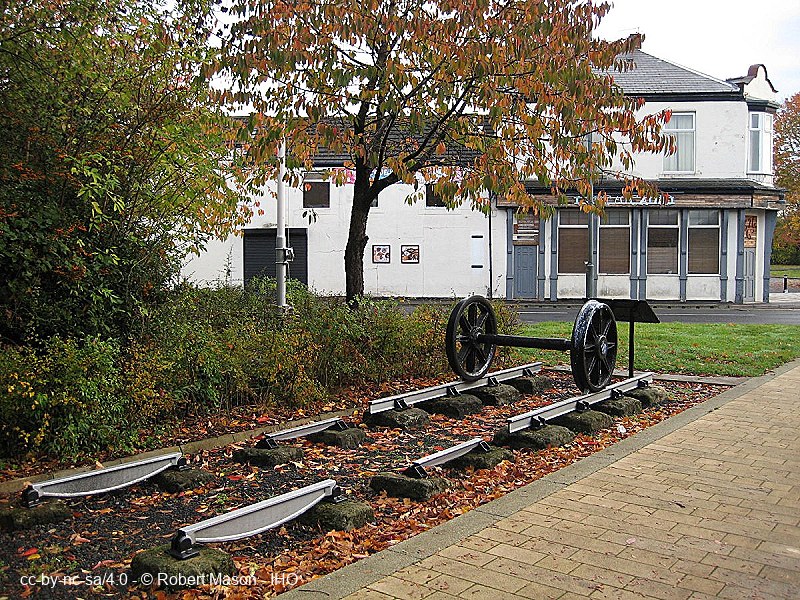
The Masons Arms pub (the building behind you as you read this), was an inn built to provide refreshment for workers and travellers on the railway and for a short while acted as a ticket office. It gave its name to the place the road and railway crossed 'Masons Arms Crossing',
Stone Blocks
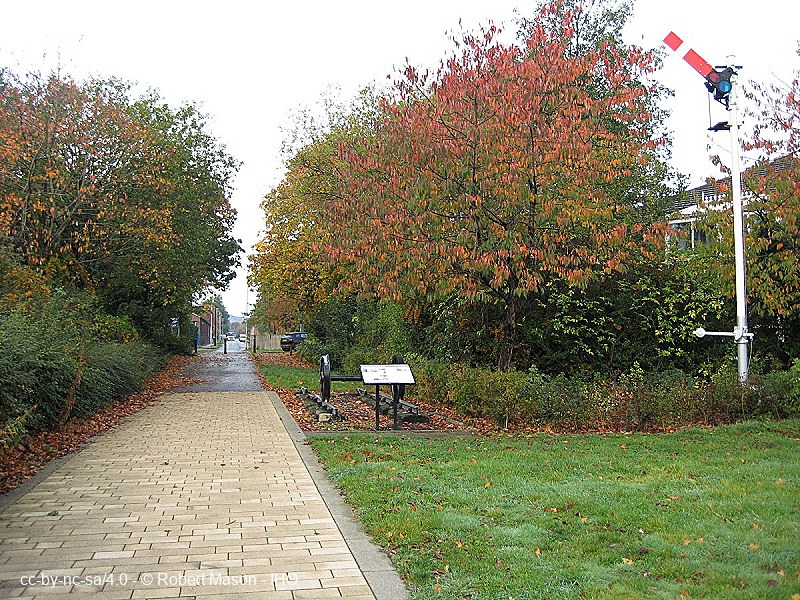
These stone blocks in front of you once supported the metal rails of the Stockton & Darlington Railway. If you look closely, you'll see that some are smaller than others and some have only two drilled holes while others have four. Railway technology developed very quickly in the 1820s and it was soon discovered that heavy engines and trains rocked the smaller stones out of position and cracked the short 'fish bellied' cast iron lengths of rail. Soon larger blocks were used with heavier four-hole iron 'chairs' which firmly gripped longer lengths of stronger but flexible 'malleable' iron rail of similar appearance to modern ones. The S&DR pioneered much of this early railway development so that later railways across the UK and internationally benefitted from the lessons learnt here. Looking beyond the sleeper stones, you can see the line of the old track bed, now a road, stretching away into the distance to the top of the Brusselton Incline and then on to West Auckland and Etherley, each with engine houses which hauled laden waggons up and down delivering them to Shildon where locomotive engines took over.
Bicentenary of the S&DR
In 2025, the S&DR will be 200 years old. This is a major anniversary in world history. Without the locomotive drawn railway the modern world would be very different. It is here that it all began on 26 miles of track between Witton Park and Stockton."
Further Reading and References :-
No references for this site
Help us improve this entry
Grid Ref :- NZ 2287 2565
Co-ordinates :- Lat 54.625476 , Long -1.647298
Local Authority :- Durham County Council
Pre 1974 County :- County Durham
Site Status :- Site extant - No Protection
Various objects and memorials to the place where Locomotion began its historic journey on the Stockton & Darlington Railway, driven by George Stephenson on 27 September 1825.
Information panel:
"You are standing at the Masons Arms Crossing, a place of importance in world history where on the 27th of September 1825 the steam engine 'Locomotion No.1' began a journey first hauling coal, goods and passengers to Darlington and then on to Stockton. Thousands of people came to watch this new technological marvel, and instead of an expected few hundred passengers significantly more clambered on board for the ride that day. The S&DR was designed and engineered by George Stephenson and financed by the business community of south Durham and North Yorkshire, inspired by the vision of the Quaker merchant Edward Pease. This was the beginning of the railway age, and inspired by the S&DR, railways were soon being built across Europe and the USA. This transformed the world with the fast movement of people and goods changing people's lives as dramatically as the internet has in the 21st century.
Before the S&DR there was nothing here at New Shildon. John Dixon who surveyed the line in 1821 remembered that 'the site of New Shildon Works was a wet, swampy field a likely place to find a snipe, or a flock of peewits'. Within a few years it had become the world's first railway town with houses, schools, chapels and the engine and waggon works; a proud tradition carried on until 1984 when the works closed.
The Masons Arms pub (the building behind you as you read this), was an inn built to provide refreshment for workers and travellers on the railway and for a short while acted as a ticket office. It gave its name to the place the road and railway crossed 'Masons Arms Crossing',
Stone Blocks
These stone blocks in front of you once supported the metal rails of the Stockton & Darlington Railway. If you look closely, you'll see that some are smaller than others and some have only two drilled holes while others have four. Railway technology developed very quickly in the 1820s and it was soon discovered that heavy engines and trains rocked the smaller stones out of position and cracked the short 'fish bellied' cast iron lengths of rail. Soon larger blocks were used with heavier four-hole iron 'chairs' which firmly gripped longer lengths of stronger but flexible 'malleable' iron rail of similar appearance to modern ones. The S&DR pioneered much of this early railway development so that later railways across the UK and internationally benefitted from the lessons learnt here. Looking beyond the sleeper stones, you can see the line of the old track bed, now a road, stretching away into the distance to the top of the Brusselton Incline and then on to West Auckland and Etherley, each with engine houses which hauled laden waggons up and down delivering them to Shildon where locomotive engines took over.
Bicentenary of the S&DR
In 2025, the S&DR will be 200 years old. This is a major anniversary in world history. Without the locomotive drawn railway the modern world would be very different. It is here that it all began on 26 miles of track between Witton Park and Stockton."
The compilers welcome corrections or additional information on all sites.
Any information provided will be verified before appearing on the web site.
Email comments
Contributor :- Robert Mason - 21 October 2026
Copyright :- cc-by-nc-sa 4.0 © Robert Mason
Copyright :- cc-by-nc-sa 4.0 © Robert Mason