Industrial History Online
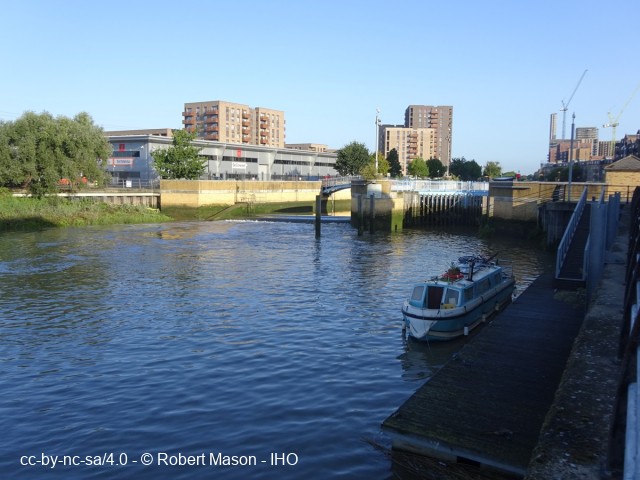
River Roding Navigation
Key Words :- river navigation
Address :- London, Greater London
Grid Ref :- TQ 4479 8282
Co-ordinates :- Lat 51.525738 , Long 0.085753
Local Authority :- Barking and Dagenham London Borough Council
Pre 1974 County :- Essex
Description and History of Site:-
The river from Barking was made navigable to Ilford Bridge 1.75 mile by Joseph Goodman, a local landowner. Act, 1737, gave him authority to set up floodgates at Town Quay (qv). The 16 ft 4 ins wide "four gates" removed, 1968, and left alongside opening winch by Mill.
Information from John Lewis: 'In 1737 an Act of Parliament was passed to make navigable, for barges and other flat-bottomed craft, the 1.75 mile stretch of the River Roding from above Barking Mill-pool to below Ilford Bridge. To maintain an adequate depth of water, a single pair of tidal doors was constructed to allow vessels to pass through on the tide and then closed to maintain the head of water. A set of sluice gates was also required to prevent flooding of the land upstream. Although there must have already been some form of river gates/sluices for use by the tidemill. The navigation continued in use until about the 1960s since when all the gates and fixtures have been removed except for the partial remains of one 19th-century winch made by Embleton's of Southwark.'
Further Reading and References:-
No references for this site
Help us improve this entry
Grid Ref :- TQ 4479 8282
Co-ordinates :- Lat 51.525738 , Long 0.085753
Local Authority :- Barking and Dagenham London Borough Council
Pre 1974 County :- Essex
The river from Barking was made navigable to Ilford Bridge 1.75 mile by Joseph Goodman, a local landowner. Act, 1737, gave him authority to set up floodgates at Town Quay (qv). The 16 ft 4 ins wide "four gates" removed, 1968, and left alongside opening winch by Mill.
Information from John Lewis: 'In 1737 an Act of Parliament was passed to make navigable, for barges and other flat-bottomed craft, the 1.75 mile stretch of the River Roding from above Barking Mill-pool to below Ilford Bridge. To maintain an adequate depth of water, a single pair of tidal doors was constructed to allow vessels to pass through on the tide and then closed to maintain the head of water. A set of sluice gates was also required to prevent flooding of the land upstream. Although there must have already been some form of river gates/sluices for use by the tidemill. The navigation continued in use until about the 1960s since when all the gates and fixtures have been removed except for the partial remains of one 19th-century winch made by Embleton's of Southwark.'
The compilers welcome corrections or additional information on all sites.
Any information provided will be verified before appearing on the web site.
Email comments
Contributor :- GLIAS Database - 2 June 2018
Copyright :- cc-by-nc-sa 4.0 © GLIAS Database
Copyright :- cc-by-nc-sa 4.0 © GLIAS Database