Industrial History Online
Wharncliffe Viaduct
Key Words :- railway viaduct
Address :- adjacent Uxbridge Road, Hanwell, London, Greater London, UB1 3ER
Grid Ref :- TQ 14922 80399
Co-ordinates :- Lat 51.510841 , Long -0.345364
Local Authority :- Ealing London Borough Council
Pre 1974 County :- Middlesex
Site Status :- Listed - Grade I
Historic England List No :- 1358811,
Site Condition :- Operational site, in use for original purpose
Site Dates :- 1838 -
Description and History of Site:-
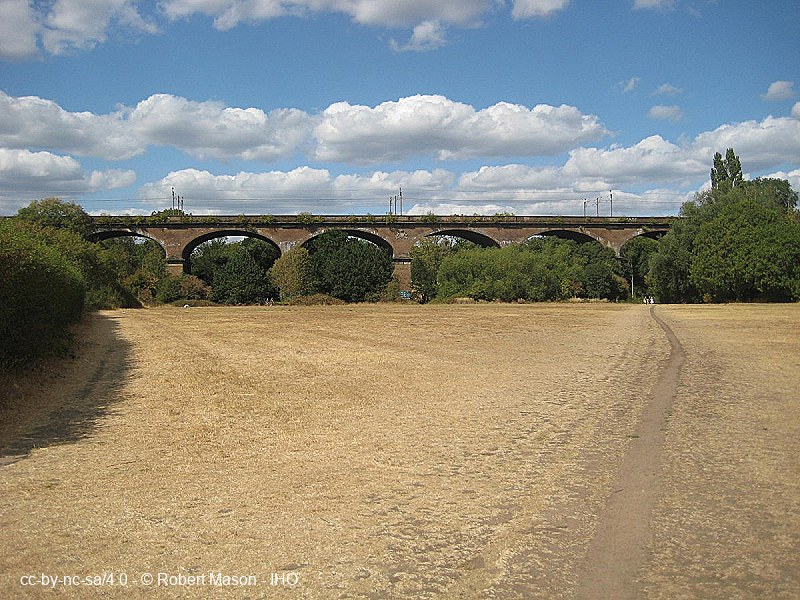
Superb eight-arch yellow-brick viaduct by I K Brunel, 1838, carrying GWR main line across valley of River Brent. Quadrupled 1877, Wharncliffe coat of arms on centre pier, south side. 270m long rises to over 25m, consists of 8 arches of more than 20m. Lord Wharncliffe steered the GWR Act through Parliament.
Information panel:
You are now standing under the Grade I listed, 8-arched viaduct which is a monument to the engineer Isambard Kingdom Brunel, who in the latter part of the 19th Century, acquired a reputation as national hero, symbolising the energy and enterprise of the Industrial Revolution. In 1832 at the age of only 26 Brunel’s sheer energy and personality came to the attention of Bristol merchants interested in forming a new railway company linking the port and their Bristol businesses to London by rail.
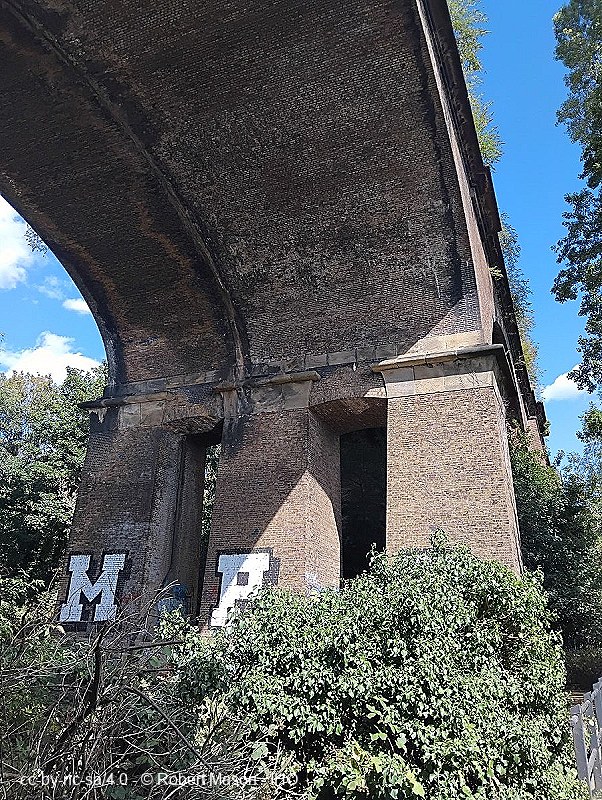
Wharncliffe Viaduct is named after the Lord who steered the GWR Bill through Parliament and was jointly designed with Brunel’s father, Marc, who was influenced by the Egyptian style. The structure consists of a series of arches formed by hollow piers made of engineering brick. It was the first viaduct to be built this way and was completed at a cost of £162,000 in July 1837. It is at an elevation of 20 metres.
The line was originally built to Brunel’s broad gauge of 7ft ¼ inch and opened to Maidenhead in June 1838. It was converted to standard gauge in 1871 and the growing demand for rail travel meant that the viaduct had to be widened around that time. The join between the two sections can be easily discerned.
In the Second World War it was a major target for the German Luftwaffe, but no direct hits were recorded, although the surrounding area suffered. The Viaduct today carries loads and levels of traffic never contemplated in 1837, testimony to the skill and determination of the Brunels. The idea of it being a London-Bristol port to port link fell victim to improvements in ship design and size, many made possible by Brunel himself.
The viaduct was Brunel’s first major railway project and Hanwell also has his last, the “Three Bridges” at Windmill Lane.
Further Reading and References:-
Wilson, Aubrey. 'London's Industrial Heritage'. David & Charles, 1967
Ashdown, John; Bussell, Michael; Carter, Paul. 'A Survey of Industrial Monuments of Greater London'. Thames Basin Archaeological Observers' Group, 1969
Cossons, Neil. 'The BP Book of Industrial Archaeology'. David & Charles, 1975
Pugsley, Sir Alfred [ed]. 'The Works of Isambard Kingdom Brunel: An Engineering Appreciation'. Cambridge University Press, 1976
Falconer, Keith. 'Guide to England's Industrial Heritage'. Batsford, 1980
Beckett, Derrick. 'Brunel's Britain'. David & Charles, 1980
Jones, Edgar. 'Industrial Architecture in Britain 1750-1939'. Batsford, 1985
Bonanza, Michael R. 'Historic Railway Sites in Britain'. Robert Hale, 1987
Smith, Denis. 'Civil Engineering Heritage - London and the Thames Valley'. Institution of Civil Engineers, 2001
Falconer, Jonathan. 'In the Footsteps of I K Brunel'. Ian Allen Publishing, 2014
https://www.ealingcivicsociety.org/lists/files/files/Wharncliffe%20Viaduct%20interpretation%20sign.pdf
http://www.glias.org.uk/news/148news.html#C
Help us improve this entry
Grid Ref :- TQ 14922 80399
Co-ordinates :- Lat 51.510841 , Long -0.345364
Local Authority :- Ealing London Borough Council
Pre 1974 County :- Middlesex
Site Status :- Listed - Grade I
Historic England List No :- 1358811,
Site Condition :- Operational site, in use for original purpose
Site Dates :- 1838 -
Superb eight-arch yellow-brick viaduct by I K Brunel, 1838, carrying GWR main line across valley of River Brent. Quadrupled 1877, Wharncliffe coat of arms on centre pier, south side. 270m long rises to over 25m, consists of 8 arches of more than 20m. Lord Wharncliffe steered the GWR Act through Parliament.
Information panel:
You are now standing under the Grade I listed, 8-arched viaduct which is a monument to the engineer Isambard Kingdom Brunel, who in the latter part of the 19th Century, acquired a reputation as national hero, symbolising the energy and enterprise of the Industrial Revolution. In 1832 at the age of only 26 Brunel’s sheer energy and personality came to the attention of Bristol merchants interested in forming a new railway company linking the port and their Bristol businesses to London by rail.
Wharncliffe Viaduct is named after the Lord who steered the GWR Bill through Parliament and was jointly designed with Brunel’s father, Marc, who was influenced by the Egyptian style. The structure consists of a series of arches formed by hollow piers made of engineering brick. It was the first viaduct to be built this way and was completed at a cost of £162,000 in July 1837. It is at an elevation of 20 metres.
The line was originally built to Brunel’s broad gauge of 7ft ¼ inch and opened to Maidenhead in June 1838. It was converted to standard gauge in 1871 and the growing demand for rail travel meant that the viaduct had to be widened around that time. The join between the two sections can be easily discerned.
In the Second World War it was a major target for the German Luftwaffe, but no direct hits were recorded, although the surrounding area suffered. The Viaduct today carries loads and levels of traffic never contemplated in 1837, testimony to the skill and determination of the Brunels. The idea of it being a London-Bristol port to port link fell victim to improvements in ship design and size, many made possible by Brunel himself.
The viaduct was Brunel’s first major railway project and Hanwell also has his last, the “Three Bridges” at Windmill Lane.
Wilson, Aubrey. 'London's Industrial Heritage'. David & Charles, 1967
Ashdown, John; Bussell, Michael; Carter, Paul. 'A Survey of Industrial Monuments of Greater London'. Thames Basin Archaeological Observers' Group, 1969
Cossons, Neil. 'The BP Book of Industrial Archaeology'. David & Charles, 1975
Pugsley, Sir Alfred [ed]. 'The Works of Isambard Kingdom Brunel: An Engineering Appreciation'. Cambridge University Press, 1976
Falconer, Keith. 'Guide to England's Industrial Heritage'. Batsford, 1980
Beckett, Derrick. 'Brunel's Britain'. David & Charles, 1980
Jones, Edgar. 'Industrial Architecture in Britain 1750-1939'. Batsford, 1985
Bonanza, Michael R. 'Historic Railway Sites in Britain'. Robert Hale, 1987
Smith, Denis. 'Civil Engineering Heritage - London and the Thames Valley'. Institution of Civil Engineers, 2001
Falconer, Jonathan. 'In the Footsteps of I K Brunel'. Ian Allen Publishing, 2014
https://www.ealingcivicsociety.org/lists/files/files/Wharncliffe%20Viaduct%20interpretation%20sign.pdf
http://www.glias.org.uk/news/148news.html#C
The compilers welcome corrections or additional information on all sites.
Any information provided will be verified before appearing on the web site.
Email comments
Contributor :- GLIAS Database - 2 June 2018
Copyright :- cc-by-nc-sa 4.0 © GLIAS Database
Copyright :- cc-by-nc-sa 4.0 © GLIAS Database