Industrial History Online
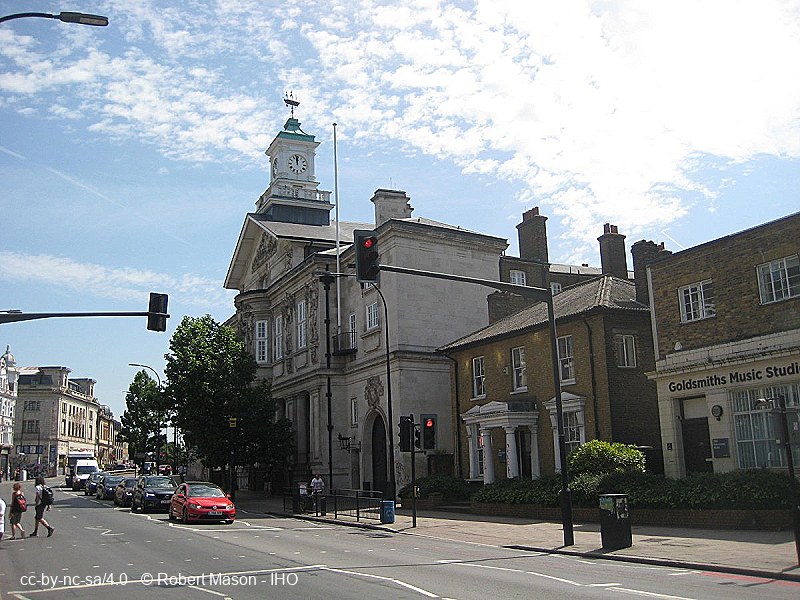
Deptford Town Hall
Key Words :- municipal
Address :- New Cross Road, London, Greater London, SE8
Grid Ref :- TQ 36369 76971
Co-ordinates :- Lat 51.475273 , Long -0.037815
Local Authority :- Lewisham London Borough Council
Pre 1974 County :- Greater London Council
Site Status :- Listed - Grade II
Historic England List No :- 1193691,
Site Dates :- 1903 -
Description and History of Site:-
Much decorated building dating from 1903, built for metropolitan borough of Deptford, with statues and reliefs of famous seamen and battles. Sailship weathervane a replica since original stolen in 1990? Now occupied by Goldsmiths College.
SELIA (1982): 'This florid local government building, dating from 1903, was built for the Metropolitan Borough of Deptford. The statues and reliefs of famous seamen and battles indicate Deptford’s maritime past. The architects, Lanchester and Rickards, also designed Westminster Central Hall. (For the adjoining public baths, see GTL04645)'
information panel:
This building opened in 1905 as the municipal centre for the former Metropolitan Borough of Deptford, which merged administratively with Lewisham in the 1960s. The building was acquired by Goldsmiths, University of London, in the late 1990s.
Its symbolic decoration raises difficult questions about how to deal with historic celebrations of those who wielded imperial power, subjugating other nations and enslaving their people.
From left to right, the four statues in the niches at the front of the Grade II-listed building represent naval figures:
Sir Francis Drake (c. 1540-1596) made at least three royally sponsored trips to West Africa to kidnap Africans and sell them. Elizabeth I awarded Drake a knighthood in 1581 which he received on the Golden Hind in Deptford.
Robert Blake (1598-1657) was an admiral who served under Oliver Cromwell throughout the English Civil War. He fought the Dutch to secure the trade triangle between the Caribbean, West Africa and England. Cromwell was responsible for trafficking the first waves of enslaved people to and from the Caribbean; installing the plantation system in Jamaica; and the massacres in Drogheda (1649).
Horatio Nelson (1758-1805) was a naval flag officer whose leadership is credited with a number of decisive British victories, particularly during the Napoleonic Wars (1803 - 1815). Nelson spent a large part of his career in the Caribbean and developed an affinity with the slave owners there, with evidence suggesting he used his influence to argue against the abolitionist movement in Britain.
The fourth statue is understood to be a 'representative' figure, rather than a specific person, from the period when the building was constructed.
It shows a modern admiral, with sextant and binoculars.
Historical and contemporary contexts
These figures were selected by the borough to adorn its town hall to mark the area's long and deep maritime connections: Deptford's Royal Naval Dockyards closed less than 40 years before this building was opened. The area was intimately connected with the transatlantic slave trade, with many ships built, fitted out or repaired in the local docks before heading to Africa. Olaudah Equiano - who fought to become a freed man and was one of the key figures in the abolitionist movement - was initially trafficked to Deptford.
Modern commentators have raised concerns over the colonial imagery and their subjects' connection to the horrors of slavery in particular. The debate about how we should present and interpret such controversial symbolism continues.
Further Reading and References:-
Goldsmiths College Industrial Archaeology Group. 'The Industrial Archaeology of South-East London'. SELIA, 1982
Help us improve this entry
Grid Ref :- TQ 36369 76971
Co-ordinates :- Lat 51.475273 , Long -0.037815
Local Authority :- Lewisham London Borough Council
Pre 1974 County :- Greater London Council
Site Status :- Listed - Grade II
Historic England List No :- 1193691,
Site Dates :- 1903 -
Much decorated building dating from 1903, built for metropolitan borough of Deptford, with statues and reliefs of famous seamen and battles. Sailship weathervane a replica since original stolen in 1990? Now occupied by Goldsmiths College.
SELIA (1982): 'This florid local government building, dating from 1903, was built for the Metropolitan Borough of Deptford. The statues and reliefs of famous seamen and battles indicate Deptford’s maritime past. The architects, Lanchester and Rickards, also designed Westminster Central Hall. (For the adjoining public baths, see GTL04645)'
information panel:
This building opened in 1905 as the municipal centre for the former Metropolitan Borough of Deptford, which merged administratively with Lewisham in the 1960s. The building was acquired by Goldsmiths, University of London, in the late 1990s.
Its symbolic decoration raises difficult questions about how to deal with historic celebrations of those who wielded imperial power, subjugating other nations and enslaving their people.
From left to right, the four statues in the niches at the front of the Grade II-listed building represent naval figures:
Sir Francis Drake (c. 1540-1596) made at least three royally sponsored trips to West Africa to kidnap Africans and sell them. Elizabeth I awarded Drake a knighthood in 1581 which he received on the Golden Hind in Deptford.
Robert Blake (1598-1657) was an admiral who served under Oliver Cromwell throughout the English Civil War. He fought the Dutch to secure the trade triangle between the Caribbean, West Africa and England. Cromwell was responsible for trafficking the first waves of enslaved people to and from the Caribbean; installing the plantation system in Jamaica; and the massacres in Drogheda (1649).
Horatio Nelson (1758-1805) was a naval flag officer whose leadership is credited with a number of decisive British victories, particularly during the Napoleonic Wars (1803 - 1815). Nelson spent a large part of his career in the Caribbean and developed an affinity with the slave owners there, with evidence suggesting he used his influence to argue against the abolitionist movement in Britain.
The fourth statue is understood to be a 'representative' figure, rather than a specific person, from the period when the building was constructed.
It shows a modern admiral, with sextant and binoculars.
Historical and contemporary contexts
These figures were selected by the borough to adorn its town hall to mark the area's long and deep maritime connections: Deptford's Royal Naval Dockyards closed less than 40 years before this building was opened. The area was intimately connected with the transatlantic slave trade, with many ships built, fitted out or repaired in the local docks before heading to Africa. Olaudah Equiano - who fought to become a freed man and was one of the key figures in the abolitionist movement - was initially trafficked to Deptford.
Modern commentators have raised concerns over the colonial imagery and their subjects' connection to the horrors of slavery in particular. The debate about how we should present and interpret such controversial symbolism continues.
Goldsmiths College Industrial Archaeology Group. 'The Industrial Archaeology of South-East London'. SELIA, 1982
The compilers welcome corrections or additional information on all sites.
Any information provided will be verified before appearing on the web site.
Email comments
Contributor :- GLIAS Database - 2 June 2018
Copyright :- cc-by-nc-sa 4.0 © GLIAS Database
Copyright :- cc-by-nc-sa 4.0 © GLIAS Database