Industrial History Online
Portland Road railway bridge
Key Words :- railway
Address :- Portland Road, South Norwood, London, Greater London
Grid Ref :- TQ 3410 6841
Co-ordinates :- Lat 51.398881 , Long -0.073706
Local Authority :- Croydon London Borough Council
Pre 1974 County :- Surrey
Site Status :- Site extant - No Protection
Site Condition :- Operational site, in use for original purpose
Description and History of Site:-
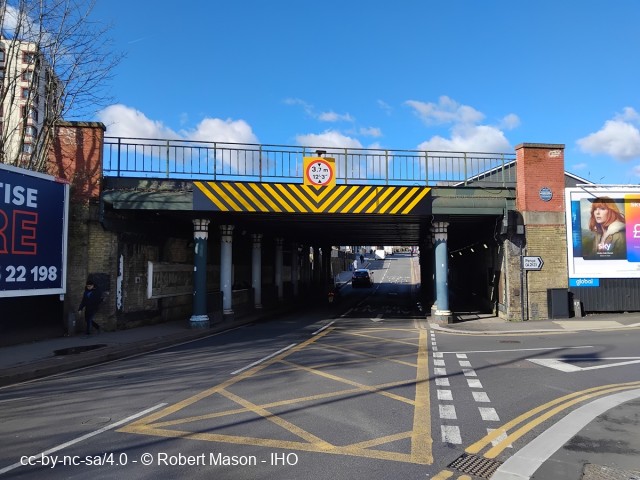
Railway bridge [240-LBW] over Portland Road (A215), South Norwood - the original was probably built c. 1838 for the London & Croydon Railway, and was certainly in place by 1847 (shown on Roberts' map.)
The bridge was the scene of two historically important accidents, and has been rebuilt two or three times. The present bridge was rebuilt in or after 1891 and has a span of 42 feet across the carriageway and two footpaths, steel girders on English bond yellow brick abutments, with a row of iron or steel support columns alongside each footpath.
The 1838 bridge had a span of 20 feet, over a carriageway without footpaths. It was rebuilt in 1859 in conjunction with the re-siting and re-building (and re-naming) of the railway station, with a span of 26 feet 9 inches, and widened to accommodate seven tracks, supported on 14 cast iron girders. One track (used only for shunting) was lifted c. 1872. On 10 December 1876 a shunting engine ran off the unprotected end of the remaining shunting track and fell onto the pair of girders which had previously supported the lifted portion. The two girders failed and were precipitated, with the locomotive, into Portland Road. The driver suffered a broken arm, but fortunately there were no other injuries. It was concluded that, apart from the brittleness of cast iron leading to failure under impact, the girders were in any case not strong enough to bear the weight of 1870s locomotives, which were significantly heavier than those of 1839.
The Board of Trade refused to sanction any further cast-iron under-line bridges (other than arch bridges) with effect from August 1883. In November 1884 the BoT circularised railway companies to enquire what steps they were taking to ensure the safety of existing cast-iron bridges. It is thought that the LBSCR had taken little or no action.
In 1890-91 Croydon Corporation expressed a wish that the bridge be widened (i.e. increased road width) The LBSCR Board on 27 January 1891 invited tenders for a wider bridge with wrought-iron girders - Croydon Corporation to contribute £3,000 towards the estimated cost of £4,233. Nothing was done before the second bridge failure.
On 1 May 1891 there was a further bridge failure here, one of a pair of girders collapsing under the weight of an up locomotive and passenger train from Brighton, travelling at 40 m.p.h. The train was the all-first-class City Limited, 08.45 from Brighton to London Bridge. The locomotive and train were derailed, but again without serious casualties. An enquiry by LBSCR revealed that the company had 181 iron underbridges on its lines. As a result cast-iron railway bridges were replaced throughout the country.
The Board of Trade report established that one of the failed girders had been internally flawed during manufacture, although this was not detectable by visual inspection and the girder had passed testing in 1886. The girders were, however, insufficiently strong and failed to meet BoT requirements for the weight of 1891 traffic in any case.
There are decorative murals incorporating representations of South Norwood's history, including industries and transport developments, on the abutment wall of the southern footway.
[Detailed information from LBSCR Board Minutes supplied by Edward Hart]
Probably the first railway bridge here was opened with the London & Croydon Railway in 1839 - at almost exactly this location the Croydon Canal had previously passed at a lower level below a swing bridge carrying Portland Road - the railway bridge is shown on W. Roberts' map of 1847. Portland Road crossed the canal by a swing bridge.
Further Reading and References:-
http://www.glias.org.uk/news/213news.html#T
Help us improve this entry
Grid Ref :- TQ 3410 6841
Co-ordinates :- Lat 51.398881 , Long -0.073706
Local Authority :- Croydon London Borough Council
Pre 1974 County :- Surrey
Site Status :- Site extant - No Protection
Site Condition :- Operational site, in use for original purpose
Railway bridge [240-LBW] over Portland Road (A215), South Norwood - the original was probably built c. 1838 for the London & Croydon Railway, and was certainly in place by 1847 (shown on Roberts' map.)
The bridge was the scene of two historically important accidents, and has been rebuilt two or three times. The present bridge was rebuilt in or after 1891 and has a span of 42 feet across the carriageway and two footpaths, steel girders on English bond yellow brick abutments, with a row of iron or steel support columns alongside each footpath.
The 1838 bridge had a span of 20 feet, over a carriageway without footpaths. It was rebuilt in 1859 in conjunction with the re-siting and re-building (and re-naming) of the railway station, with a span of 26 feet 9 inches, and widened to accommodate seven tracks, supported on 14 cast iron girders. One track (used only for shunting) was lifted c. 1872. On 10 December 1876 a shunting engine ran off the unprotected end of the remaining shunting track and fell onto the pair of girders which had previously supported the lifted portion. The two girders failed and were precipitated, with the locomotive, into Portland Road. The driver suffered a broken arm, but fortunately there were no other injuries. It was concluded that, apart from the brittleness of cast iron leading to failure under impact, the girders were in any case not strong enough to bear the weight of 1870s locomotives, which were significantly heavier than those of 1839.
The Board of Trade refused to sanction any further cast-iron under-line bridges (other than arch bridges) with effect from August 1883. In November 1884 the BoT circularised railway companies to enquire what steps they were taking to ensure the safety of existing cast-iron bridges. It is thought that the LBSCR had taken little or no action.
In 1890-91 Croydon Corporation expressed a wish that the bridge be widened (i.e. increased road width) The LBSCR Board on 27 January 1891 invited tenders for a wider bridge with wrought-iron girders - Croydon Corporation to contribute £3,000 towards the estimated cost of £4,233. Nothing was done before the second bridge failure.
On 1 May 1891 there was a further bridge failure here, one of a pair of girders collapsing under the weight of an up locomotive and passenger train from Brighton, travelling at 40 m.p.h. The train was the all-first-class City Limited, 08.45 from Brighton to London Bridge. The locomotive and train were derailed, but again without serious casualties. An enquiry by LBSCR revealed that the company had 181 iron underbridges on its lines. As a result cast-iron railway bridges were replaced throughout the country.
The Board of Trade report established that one of the failed girders had been internally flawed during manufacture, although this was not detectable by visual inspection and the girder had passed testing in 1886. The girders were, however, insufficiently strong and failed to meet BoT requirements for the weight of 1891 traffic in any case.
There are decorative murals incorporating representations of South Norwood's history, including industries and transport developments, on the abutment wall of the southern footway.
[Detailed information from LBSCR Board Minutes supplied by Edward Hart]
Probably the first railway bridge here was opened with the London & Croydon Railway in 1839 - at almost exactly this location the Croydon Canal had previously passed at a lower level below a swing bridge carrying Portland Road - the railway bridge is shown on W. Roberts' map of 1847. Portland Road crossed the canal by a swing bridge.
http://www.glias.org.uk/news/213news.html#T
The compilers welcome corrections or additional information on all sites.
Any information provided will be verified before appearing on the web site.
Email comments
Contributor :- GLIAS Database - 2 June 2018
Copyright :- cc-by-nc-sa 4.0 © GLIAS Database
Copyright :- cc-by-nc-sa 4.0 © GLIAS Database