Industrial History Online
George Spill's Vulcanised Rubber Works
Key Words :- works
Address :- 75 Wallis Road, Hackney Wick, London, Greater London, E9 5LN
Grid Ref :- TQ 3708 8471
Co-ordinates :- Lat 51.544644 , Long -0.024578
Local Authority :- Hackney London Borough Council
Pre 1974 County :- London
Site Status :- Site extant - No Protection
Site Dates :- 1861 -
Description and History of Site:-
The vulcanised rubber works are thought to be the oldest survivors of their kind in London and is most historically significant industrial building in the Hackney Wick area.
Appraisal (2014):
George Spill's Vulcanised Rubber Works buildings (1861)
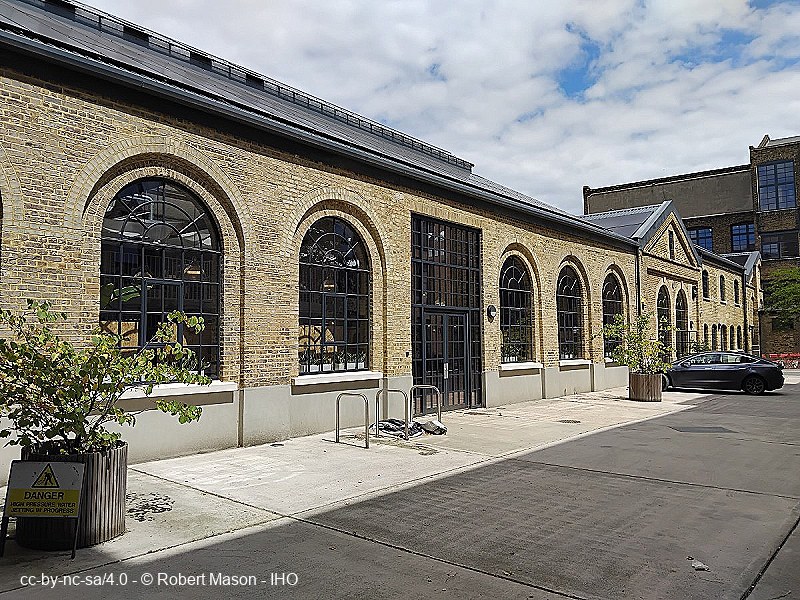
The buildings set back from Wallis Road and west of the tall Central Books warehouse (qv), are the surviving elements of George Spill’s Vulcanised Rubber Works (1861). In stock brick with arched detailing they form a group with Central Books.
The three-storey back addition to the back of Central Books adjoins the former rubber works which occupied buildings immediately to the west including a stock brick building with white brick round-headed arches and key stones and, to the west of that, a shed with three white segmental window arches.
Between 1864 and 1874, Spill’s works were used for the manufacture of the world's first plastic – Parkesine. Sheds, c.1866, running parallel to Wallis Road (behind later frontage sheds and a garage) contain attractive timber roof structures. These were part of Alexander Parke's Parkesine Co Ltd – the world's first purpose-built plastics factory. The last, most westerly bay, where the roof structure is in steel dates from the mid 20th century.
These are possibly the oldest surviving rubber works buildings in London and the world's first plastics factory. During the early 20th century these buildings formed part of the Clarnico (Clarke, Nickolls & Coombs Ltd) confectionary works that extended south of the railway line and east across the Lee Navigation. The simple, stock brick warehouse at the corner of Wallis and Berkshire Roads is in poor condition but, to some degree, has townscape merit and contributes positively to the character and appearance of the conservation area.
Plaque:
FIRST PLASTIC IN THE WORLD
Known as 'parkesine', invented by Alexander Parkes. First made near the site, 1866 at the Parkesine Works.
Occupied (2026) by HTA Design.
Further Reading and References:-
Smith, Tim and Carr, Bob. 'A Guide to the Industrial Archaeology of Hertfordshire and the Lea Valley'. Association for Industrial Archaeology, 2004
Hackney Wick Conservation Area Appraisal, 2014
Hackney Wick and the Old Ford Area Characterisation Study and Assessment of Key Buildings Compiled for EDAW Ltd
https://www.hta.co.uk/place/75-wallis-road
Help us improve this entry
Grid Ref :- TQ 3708 8471
Co-ordinates :- Lat 51.544644 , Long -0.024578
Local Authority :- Hackney London Borough Council
Pre 1974 County :- London
Site Status :- Site extant - No Protection
Site Dates :- 1861 -
The vulcanised rubber works are thought to be the oldest survivors of their kind in London and is most historically significant industrial building in the Hackney Wick area.
Appraisal (2014):
George Spill's Vulcanised Rubber Works buildings (1861)
The buildings set back from Wallis Road and west of the tall Central Books warehouse (qv), are the surviving elements of George Spill’s Vulcanised Rubber Works (1861). In stock brick with arched detailing they form a group with Central Books.
The three-storey back addition to the back of Central Books adjoins the former rubber works which occupied buildings immediately to the west including a stock brick building with white brick round-headed arches and key stones and, to the west of that, a shed with three white segmental window arches.
Between 1864 and 1874, Spill’s works were used for the manufacture of the world's first plastic – Parkesine. Sheds, c.1866, running parallel to Wallis Road (behind later frontage sheds and a garage) contain attractive timber roof structures. These were part of Alexander Parke's Parkesine Co Ltd – the world's first purpose-built plastics factory. The last, most westerly bay, where the roof structure is in steel dates from the mid 20th century.
These are possibly the oldest surviving rubber works buildings in London and the world's first plastics factory. During the early 20th century these buildings formed part of the Clarnico (Clarke, Nickolls & Coombs Ltd) confectionary works that extended south of the railway line and east across the Lee Navigation. The simple, stock brick warehouse at the corner of Wallis and Berkshire Roads is in poor condition but, to some degree, has townscape merit and contributes positively to the character and appearance of the conservation area.
Plaque:
FIRST PLASTIC IN THE WORLD
Known as 'parkesine', invented by Alexander Parkes. First made near the site, 1866 at the Parkesine Works.
Occupied (2026) by HTA Design.
Smith, Tim and Carr, Bob. 'A Guide to the Industrial Archaeology of Hertfordshire and the Lea Valley'. Association for Industrial Archaeology, 2004
Hackney Wick Conservation Area Appraisal, 2014
Hackney Wick and the Old Ford Area Characterisation Study and Assessment of Key Buildings Compiled for EDAW Ltd
https://www.hta.co.uk/place/75-wallis-road
The compilers welcome corrections or additional information on all sites.
Any information provided will be verified before appearing on the web site.
Email comments
Contributor :- GLIAS Database - 15 June 2026
Copyright :- cc-by-nc-sa 4.0 © GLIAS Database
Copyright :- cc-by-nc-sa 4.0 © GLIAS Database