Industrial History Online
The Cob
Key Words :- embankment
Address :- Porthmadog, Gwynedd
Grid Ref :- SH 572 384
Co-ordinates :- Lat 52.923971 , Long -4.125625
Local Authority :- Gwynedd Council
Pre 1974 County :- Caernarfonshire
Site Status :- Listed - Grade II*
CADW List No :- 5234, 85406,
Coflein Ref No :- 34165,
Heritage Gateway Ref No :- 34165,
Description and History of Site :-
Information panel:
In 1811 the new embankment across Traeth Mawr - the Cob - was one of the engineering successes of the age.
Over previous centuries others had intended to link the counties of Caernarfonshire and Meirionyddshire across Traeth Mawr, but it was William Alexander Maddocks, a native of Denbighshire who succeeded.
With the building of the Cob, Maddocks reclaimed agricultural land from the wetlands and marshes. But possibly his main aim was to take advantage of the growth in travel with Ireland and to support Port Dinllaen's case to be the main port to Ireland. However, it was Thomas Telford and Holyhead which eventually triumphed.
Construction work started in 1807. The road was opened in 1811 at a cost of £160,000. Its opening saw great celebrations, including horse races and the roasting of an ox.
Unfortunately within weeks part of the structure was destroyed in a great storm and it took a further three years for the Cob to be fully repaired.
Maddocks not only constructed the Cob but was responsible for building the new settlement of Tremadog on land he had reclaimed from the wetlands and also for much of the town of Porthmadog.
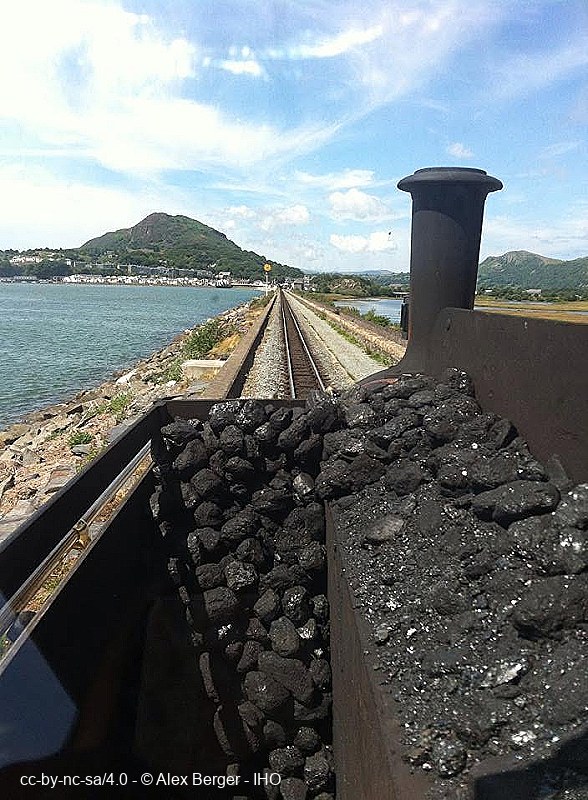
During the 1830s the Ffestiniog Railway (qv) was constructed to carry slate from the quarries at Blaenau Ffestiniog to the harbour at Porthmadog on the original Cob with a lower embankment on the inland side built to take the highway. The Cob played a major role in the growth and prosperity of Porthmadog and its harbour during the 19th century.
Over the years the Cob has withstood many violent storms, but probably the most destructive was in 1907 which resulted in damage to over half of its length.
In the year 2001 the Cob was strengthened, the roadway was widened and a new embankment built to carry a pathway for walkers and cyclists.
Gwyn and Williams (1996): 'William Alexander Madocks' most ambitious venture, which eventually bankrupted him, was to build an embankment across the bay of the Traeth Mawr from a sluice bridge at SH5717385 to SH584379. This was eventually completed in 1813. The quarries from which the rock was won may still be seen, as may the powder house for the explosives and the lime kiln where lime-mortar was produced at Ynys Cyngar (SH554366). At the point where the Glaslyn's waters scooped out a harbour he built a series of wharves, from which Ffestiniog slate came to be exported. The local shipbuilders became famous world-wide for the grace and turn of speed of the vessels they produced, the so-called 'Western Ocean Yachts’. Porthmadog grew up by these wharves, and it was in the offices of a local solicitor's firm that the young David Lloyd George began his career as a lawyer. Porthmadog harbour preserves not only its wharves and the courses of the various narrow gauge railways which served them but also a sail loft, the seamen's mission and the fragmentary remains of a limekiln (SH571384).'
Further Reading and References :-
Morgan Rees, D. 'The Industrial Archaeology of Wales'. 1975, David & Charles
Sivewright, W J [ed]. 'Civil Engineering Heritage - Wales and Western England'. Institution of Civil Engineers, 1986
Gwyn, David and Williams, Merfyn. 'A Guide to the Industrial Archaeology of North West Wales'. Association for Industrial Archaeology, 1996
Help us improve this entry
Grid Ref :- SH 572 384
Co-ordinates :- Lat 52.923971 , Long -4.125625
Local Authority :- Gwynedd Council
Pre 1974 County :- Caernarfonshire
Site Status :- Listed - Grade II*
CADW List No :- 5234, 85406,
Coflein Ref No :- 34165,
Heritage Gateway Ref No :- 34165,
Information panel:
In 1811 the new embankment across Traeth Mawr - the Cob - was one of the engineering successes of the age.
Over previous centuries others had intended to link the counties of Caernarfonshire and Meirionyddshire across Traeth Mawr, but it was William Alexander Maddocks, a native of Denbighshire who succeeded.
With the building of the Cob, Maddocks reclaimed agricultural land from the wetlands and marshes. But possibly his main aim was to take advantage of the growth in travel with Ireland and to support Port Dinllaen's case to be the main port to Ireland. However, it was Thomas Telford and Holyhead which eventually triumphed.
Construction work started in 1807. The road was opened in 1811 at a cost of £160,000. Its opening saw great celebrations, including horse races and the roasting of an ox.
Unfortunately within weeks part of the structure was destroyed in a great storm and it took a further three years for the Cob to be fully repaired.
Maddocks not only constructed the Cob but was responsible for building the new settlement of Tremadog on land he had reclaimed from the wetlands and also for much of the town of Porthmadog.
During the 1830s the Ffestiniog Railway (qv) was constructed to carry slate from the quarries at Blaenau Ffestiniog to the harbour at Porthmadog on the original Cob with a lower embankment on the inland side built to take the highway. The Cob played a major role in the growth and prosperity of Porthmadog and its harbour during the 19th century.
Over the years the Cob has withstood many violent storms, but probably the most destructive was in 1907 which resulted in damage to over half of its length.
In the year 2001 the Cob was strengthened, the roadway was widened and a new embankment built to carry a pathway for walkers and cyclists.
Gwyn and Williams (1996): 'William Alexander Madocks' most ambitious venture, which eventually bankrupted him, was to build an embankment across the bay of the Traeth Mawr from a sluice bridge at SH5717385 to SH584379. This was eventually completed in 1813. The quarries from which the rock was won may still be seen, as may the powder house for the explosives and the lime kiln where lime-mortar was produced at Ynys Cyngar (SH554366). At the point where the Glaslyn's waters scooped out a harbour he built a series of wharves, from which Ffestiniog slate came to be exported. The local shipbuilders became famous world-wide for the grace and turn of speed of the vessels they produced, the so-called 'Western Ocean Yachts’. Porthmadog grew up by these wharves, and it was in the offices of a local solicitor's firm that the young David Lloyd George began his career as a lawyer. Porthmadog harbour preserves not only its wharves and the courses of the various narrow gauge railways which served them but also a sail loft, the seamen's mission and the fragmentary remains of a limekiln (SH571384).'
Morgan Rees, D. 'The Industrial Archaeology of Wales'. 1975, David & Charles
Sivewright, W J [ed]. 'Civil Engineering Heritage - Wales and Western England'. Institution of Civil Engineers, 1986
Gwyn, David and Williams, Merfyn. 'A Guide to the Industrial Archaeology of North West Wales'. Association for Industrial Archaeology, 1996
The compilers welcome corrections or additional information on all sites.
Any information provided will be verified before appearing on the web site.
Email comments
Contributor :- Robert Mason - 13 July 2024
Copyright :- cc-by-nc-sa 4.0 © Robert Mason
Copyright :- cc-by-nc-sa 4.0 © Robert Mason